Project Management

Effective task management is the backbone of any operation that actually scales — and if your team is currently running it through WhatsApp, you already know something is starting to crack. Maybe it's the missed follow-ups buried under weekend memes. Maybe it's the new hire who can't find that critical brief from three months ago. Or maybe it's you, at 9 PM, scrolling through group chat history trying to confirm who was supposed to own the vendor renewal. WhatsApp was built for personal messaging. As teams grow, the gap between what it was designed to do and what operations actually demands becomes a serious liability.
This is not a criticism of the app itself — it's an exceptionally well-designed consumer tool. But task management in a growing SMB requires structure that chat simply cannot provide. Ownership, deadlines, status visibility, cross-team coordination, and institutional memory are not features WhatsApp has. Yet millions of small business teams rely on it daily as a de facto work management system, and the operational cost of that workaround compounds with every new hire, every new project, and every missed handoff.
According to McKinsey's workplace research, employees spend nearly 20% of their working week searching for information or tracking down colleagues for updates. In a 10-person team, that's two full-time equivalents lost to coordination overhead. When that coordination is happening in an unstructured chat environment, the number only grows.
The CRACK Model: How WhatsApp Breaks Task Management at Scale
To diagnose exactly where chat-based task management fails, it helps to have a model. Call it the CRACK Model — five structural failure points that appear predictably as teams grow beyond the point where everyone is in the same room. Each letter represents a dimension of task management that WhatsApp fundamentally cannot support at scale: Clarity, Record, Accountability, Coordination, and Knowledge. Understanding each one gives you a precise vocabulary for the problems you're already experiencing — and a roadmap for fixing them.
C — Clarity: Task Management Without Structure Produces Ambiguity
In WhatsApp, a task is just a sentence in a stream of sentences. "Can someone handle the supplier quote by Thursday?" sits next to a GIF and a lunch order. There's no assignee field, no due date, no status. Task management requires clarity — who owns it, when it's due, and what done looks like. None of that exists natively in a chat thread.
A typical ops scenario: your team discusses a client onboarding in a group chat. Three people think someone else is drafting the welcome email. No one does. The client notices. That single miscommunication costs two hours of damage control — and it traces back to a task that was never formally assigned.
R — Record: No Searchable History Means Repeated Work
WhatsApp messages technically persist, but finding a specific decision made six weeks ago in a 3,000-message group thread is not realistic. Effective task tracking depends on a searchable, structured record — not a reverse-chronological chat log.
The operational impact is real: teams re-discuss decisions that were already made, onboarding new staff requires someone to manually brief them on context that should be documented, and institutional knowledge walks out the door whenever an employee leaves. Harvard Business Review has consistently noted that unstructured communication leads to knowledge loss and duplicated effort — both of which are direct tax on your operating margin.
Operational Dimension | WhatsApp-Based Task Management | Structured Task Workflow |
|---|---|---|
Task assignment | Implied in message, often missed | Explicit owner, due date, priority |
Status visibility | Requires manual check-in message | Live status visible to all stakeholders |
File and context retrieval | Scroll-search, 10–20 min average | Attached to task, searchable instantly |
Onboarding new staff | Ad hoc briefings, knowledge loss | Self-serve process documentation |
Cross-team task coordination | Separate threads, fragmented view | Unified workspace, shared visibility |
A — Accountability: Task Tracking Needs Ownership, Not Just Mentions
Tagging someone in a WhatsApp message is not the same as assigning them a task. The @mention disappears into the feed. There's no follow-up mechanism, no reminder, no escalation path if the deadline passes. Accountability in task management means the system enforces ownership — not the manager's memory.
When you're managing a team of eight, you can probably keep track of who said they'd do what. At twenty-five people across two departments? You cannot. The overhead of manually chasing status — "Hey, did you send that report?" — becomes a significant and entirely avoidable time drain on your calendar.
Weekly Hours Lost to Manual Status-Chasing by Team Size
2 hrs
Teams of 5–10
6 hrs
Teams of 15–25
12+ hrs
Teams of 30–50
Fig 1: Estimated manager hours lost weekly to manual update-chasing in chat-only environments (illustrative, based on reported coordination overhead patterns)
C — Coordination: Cross-Team Task Workflow Breaks in Separate Chat Silos
Most SMBs have multiple WhatsApp groups: one for marketing, one for ops, one for the whole company, a few project-specific ones. When a task spans two teams — say, ops needs a deliverable from marketing to finalize a vendor proposal — there's no shared view of where it stands. You're either added to every group (noise overload) or you're left guessing.
Cross-team task coordination is precisely where structured task management earns its keep. With a shared workspace, both teams see the same task, the same deadline, and the same status update. There's no game of telephone. Asana's Anatomy of Work report found that workers switch between apps and tools an average of 10 times per hour trying to get work done — a fragmentation that WhatsApp's silo structure actively worsens.
K — Knowledge: Task Management Must Preserve Institutional Memory
Every task completed in WhatsApp leaves no usable trace. The rationale behind a decision, the file version that was approved, the client preference that was mentioned in passing — all of it vanishes into an unsearchable chat archive. When that team member leaves or that process needs to be repeated six months later, you start from zero.
Structured task tracking preserves context alongside the task itself. Files, notes, comments, and status history are all attached to the work item — not scattered across personal message threads. This is the difference between an organization that learns and one that perpetually re-learns.
Applying the CRACK Model: A Standardized Task Management Flow in Morningmate
Here is a concrete example of what transitioning from WhatsApp to structured task management looks like in practice, using a new client onboarding workflow.
The Before State (WhatsApp)
A new client signs. The ops manager sends a WhatsApp message to the group: "New client — let's get onboarding going." Over the next 48 hours, seven people respond with various updates across two separate threads. No one is formally assigned to the checklist. The welcome email goes out late. The access credentials are sent to the wrong contact. The manager spends 90 minutes reconstructing what happened for the client debrief.
The After State (Structured Task Workflow with Morningmate)
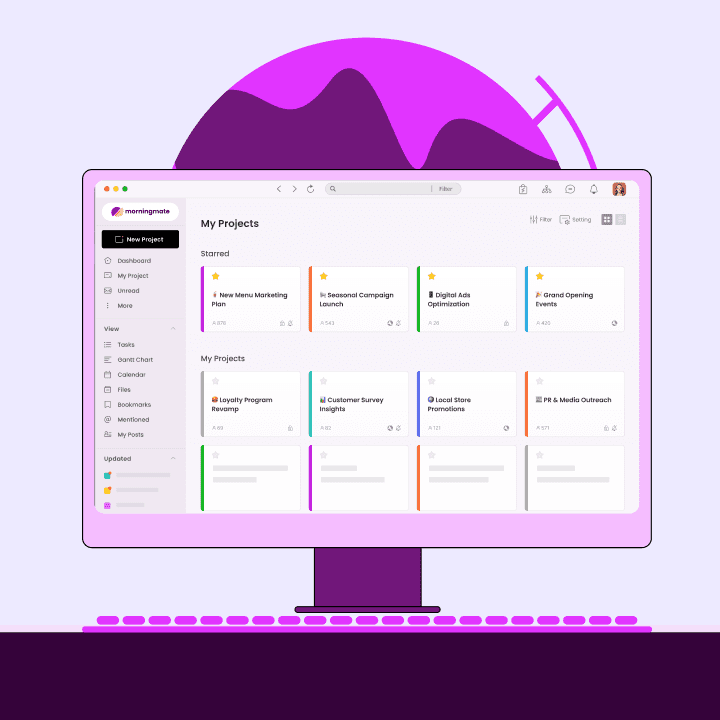
Morningmate is a lightweight work management platform used by over 550,000 teams worldwide. It combines structured task management with built-in team chat — think of it as a workspace where your task board and your team communication live side by side, without the complexity of enterprise tools like Jira or Asana.
When a new client signs, the ops manager opens Morningmate and uses a saved onboarding task template. It auto-generates six tasks — welcome email, credential setup, kickoff meeting scheduling, contract filing, internal briefing, and 7-day check-in — each with a pre-assigned owner, a due date, and a checklist attached. Every team member can see the board. Status updates happen on the task itself, not in a chat thread. When the welcome email is sent, the assignee marks it complete. No follow-up message required.
The built-in chat in Morningmate mirrors a familiar WhatsApp-style interface, so team members who are resistant to "new tools" adopt it quickly. But unlike WhatsApp, every conversation can be linked to a specific task, meaning context never gets lost. Morningmate's Feed view — which looks like a social media timeline — makes updates scannable at a glance, so the ops manager gets a live picture of the onboarding progress without sending a single "any updates?" message.
This is what the CRACK Model looks like when it's solved: Clarity (every task has an owner and deadline), Record (all context is searchable), Accountability (status is visible without prompting), Coordination (all teams see the same board), and Knowledge (the completed task becomes a template for the next onboarding).
Onboarding Step | WhatsApp Approach | Structured Task Management |
|---|---|---|
Task creation | Announcement message in group chat | Template-generated tasks, pre-assigned |
Progress tracking | Send "any updates?" messages manually | Live task board visible to all |
File sharing | Scattered across chat threads | Attached directly to relevant task |
Post-project review | No record, relies on memory | Full task history, reusable as template |
New hire access | Manual briefing from senior staff | Self-serve access to structured workspace |
The Measurable Impact of Standardized Task Management
Ops teams that migrate from chat-only coordination to structured task management consistently report three measurable improvements: faster onboarding for new hires, fewer missed deadlines, and significant reductions in the time managers spend chasing status. These are not soft gains — they show up in capacity and margin.
Reduction in Coordination Overhead After Switching to Structured Task Tracking
15%
Email-only teams
34%
Chat + basic PM
67%
Integrated task workspace
Fig 2: Estimated reduction in manager coordination overhead by tool type (illustrative, based on productivity research patterns)
Your Task Management Standardization Checklist
If you're ready to stop running operations through a consumer chat app and start building a system that scales, here is where to begin. Solid task management doesn't require a six-month rollout — it requires a clear decision and the right tool.
Audit your current task workflow: List every active project and identify where task assignments currently live. If the answer is "WhatsApp" or "in my head," that's your starting point.
Define your core task fields: Every task in your system should have an owner, a due date, a status, and at least one attached file or note. Non-negotiable.
Build two to three reusable templates: Identify your most repeated workflows (onboarding, vendor review, content approval) and create standardized task checklists for each.
Consolidate communication and task tracking into one tool: Tools like Morningmate combine built-in chat with a full task management board, so teams don't have to switch between apps to communicate and act.
Set a 30-day WhatsApp-for-work sunset: Give your team a firm date. Announce that all work tasks will be managed in the new system from that point. No hybrid period — it creates parallel confusion.
Review task management coverage weekly: For the first month, run a weekly 10-minute review to check that all active work is logged in the system and status is current. This builds the habit.
Measure the before and after: Track two metrics: time spent chasing status per week (before vs. after) and missed deadlines per month. Both should drop meaningfully within 60 days.
Task management done right is not just an operational improvement — it's a compounding advantage. Every workflow you standardize, every process you document, and every task you track in a structured system makes your team faster, your onboarding easier, and your ops more resilient to the inevitable chaos of growth. WhatsApp will keep serving your team well for what it was actually built for. Work coordination deserves a purpose-built home.