Project Management

Task management falls apart long before a team realizes it. For many growing SMBs, the breaking point arrives quietly — a missed deadline here, a duplicated effort there, a new hire who spends their first week asking colleagues where to find basic information. The culprit is almost always the same: WhatsApp. What starts as a convenient shortcut for quick coordination becomes, at scale, an operational liability that erodes the very efficiency you're trying to build.
According to McKinsey's research on workplace productivity, employees spend an average of 19% of their working week searching for information and chasing colleagues for updates. In a WhatsApp-driven operation, that number climbs higher — because conversations are buried in personal threads, decisions have no audit trail, and task coordination is entirely invisible to anyone not added to the right group chat at the right moment.
This article introduces the TRAIL framework — a five-component model designed to diagnose exactly where WhatsApp-based task management breaks down as your headcount grows, and what standardized task tracking looks like instead. Each component maps to a real operational failure mode. Work through it and you'll have a clear picture of what to fix — and in what order.
The TRAIL Framework: Why WhatsApp Breaks Task Management at Scale
TRAIL stands for Traceability, Responsibility, Accessibility, Iteration, and Load. These are the five operational dimensions that WhatsApp systematically degrades as your team grows past ten, twenty, or fifty people. Each one is manageable when you're a five-person startup. Each one becomes a compounding liability when you're not.
The framework isn't theoretical. It maps directly to the failure patterns ops managers report most frequently: no record of who agreed to what, tasks assigned in chat that nobody follows up on, new team members who can't access historical context, repeated mistakes because learnings were never documented, and managers who spend more time chasing status than actually managing. Let's break each component down.
T — Traceability: Task Management Without an Audit Trail
Every task management system needs a record of what was decided, when, and by whom. WhatsApp provides none of this in any usable form. A decision made in a group chat on Tuesday is buried under 200 messages by Thursday. By the time a dispute arises — and in growing teams, it will — there is no clean record to reference.
Consider a common ops scenario: your procurement team agrees in a WhatsApp group to approve a vendor at a specific rate. Three weeks later, the invoice arrives at a different rate. Resolving it requires scrolling through hundreds of messages, tagging the right people, and hoping someone screenshots the original conversation. A standardized task workflow captures that approval as a timestamped record, linked to the task, visible to any stakeholder with access — permanently.
Dimension | WhatsApp-Based Task Coordination | Standardized Task Management |
|---|---|---|
Decision traceability | Buried in chat history, no formal record | Timestamped, linked to task, searchable |
Task ownership | Verbal or implied, easy to deny | Formally assigned with due date and status |
Cross-team visibility | Zero — siloed in group chats | Shared workspace, role-based permissions |
Onboarding access | New hires ask colleagues repeatedly | Self-serve access to processes and history |
Status updates | Manual chasing via messages | Real-time status on each task card |
R — Responsibility: Task Coordination Without Clear Ownership
In a WhatsApp group, "Can someone handle the client brief by Friday?" is not a task assignment. It is a hope. Without a named owner, a visible due date, and a defined outcome, tasks evaporate. Everyone assumes someone else picked it up. Nobody did.
This is one of the most consistent failure modes in SMB operations. Asana's Anatomy of Work report found that unclear ownership is among the top reasons work doesn't get completed on time. Task management systems solve this by making ownership non-negotiable: a task exists, it has an assignee, and that person's name is attached to it until it is marked complete. There is no ambiguity, and there is no way to quietly let it slide.
How Teams Lose Track of Task Ownership (% of managers reporting each issue)
71%
Tasks lost in chat
63%
Unclear who owns task
58%
Duplicate work done
49%
Status chasing daily
Fig 1: Common task management failure points in WhatsApp-reliant teams (illustrative, based on reported SMB operational patterns)
A — Accessibility: Task Tracking That Breaks for New Hires
When a new operations coordinator joins your team, how do they learn your processes? If the answer is "they ask around" or "we add them to the relevant WhatsApp groups," you have an accessibility problem. Critical knowledge lives inside personal devices, inside conversation threads that predate the new hire's tenure, and inside the heads of people who may not be available when questions arise.
This is the knowledge silo problem in its purest form. Harvard Business Review has documented how information hoarding — even unintentional — slows onboarding and reduces cross-team effectiveness. Standardized task management creates a shared, searchable workspace where processes, files, and task history are accessible to anyone who needs them, from day one. It turns institutional knowledge from a liability into an asset.
I — Iteration: You Can't Improve a Task Workflow You Can't See
Process improvement requires data. You need to know how long tasks typically take, where they stall, which team members are overloaded, and which workflows repeatedly produce errors. WhatsApp gives you none of this. Every conversation disappears into the feed, and there is no aggregated view of work progress anywhere.
A proper task management system generates this data automatically. You can see, at a glance, that your vendor onboarding process consistently stalls at the document verification step — and that tells you exactly where to intervene. Without visibility into task workflow patterns, every process improvement is a guess. With it, every improvement is evidence-led.
L — Load: The Hidden Cost of Managing Work in WhatsApp
The final component is cognitive and operational load — and it is the most insidious. When task coordination happens in WhatsApp, managers become the connective tissue of every workflow. They are the ones who remember what was decided, who follows up when something goes quiet, and who re-sends context that was buried three weeks ago. This is not management. This is manual administration, and it scales terribly.
As your team grows, the load compounds. More people means more group chats, more parallel conversations, more status updates to chase, and more cognitive overhead for the people who are supposed to be leading — not coordinating logistics in a messaging app.
Applying the TRAIL Framework: A Standardized Task Management Flow in Morningmate
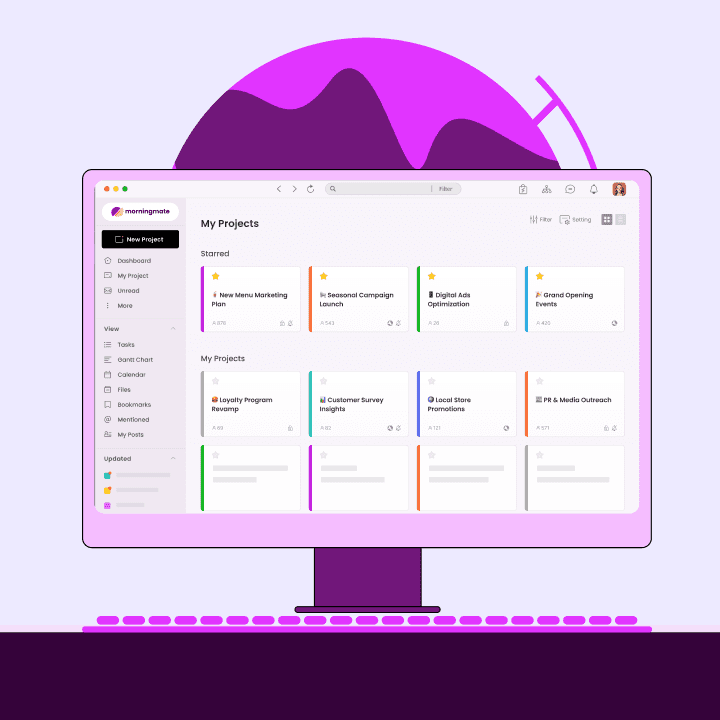
Here is a concrete, end-to-end example of what a standardized task workflow looks like when you move your operations off WhatsApp and into a purpose-built task management system like Morningmate — a lightweight work management tool used by over 550,000 teams worldwide that combines task tracking with built-in chat in a single, simple workspace.
Scenario: Monthly supplier invoice review, previously coordinated across three WhatsApp groups involving finance, procurement, and the ops manager.
Task creation with ownership: The ops manager creates a recurring task in Morningmate titled "Monthly Supplier Invoice Review — [Month]." It is assigned to the procurement lead with a hard due date and a checklist of subtasks: collect invoices, verify against POs, flag discrepancies, obtain sign-off.
File attachment at the task level: All relevant invoice files are uploaded directly to the task card — not shared in a chat thread that will scroll out of view. Anyone with access can retrieve them without asking.
Status updates visible to all stakeholders: As the procurement lead works through the checklist, they update task status: In Progress → Awaiting Sign-off → Complete. The ops manager sees this in real time without sending a single "any update?" message.
Discussion stays contextual: Questions or clarifications happen in Morningmate's built-in chat, which is structured around projects and posts — not personal phone numbers. The conversation stays linked to the work, not lost in someone's personal inbox.
Audit trail for the next cycle: When the same task recurs next month, the previous cycle's notes, files, and decisions are all still attached to the task history. Onboarding a new team member to this process takes minutes, not days.
This single workflow addresses all five TRAIL components. It is traceable, responsibility is explicit, it is accessible to new team members, it generates data for iteration, and it dramatically reduces the manual coordination load on the ops manager.
Process Step | WhatsApp Approach | Standardized Task Management |
|---|---|---|
Task assignment | Mentioned in group, easily missed | Formal card with assignee and due date |
File sharing | Attached to a chat, expires or gets lost | Attached to task card, permanently accessible |
Status visibility | Requires manual follow-up messages | Real-time status on task board |
Process repeat | Re-explained from scratch each cycle | Template reused with full history intact |
Cross-team coordination | Multiple group chats, fragmented context | Single shared workspace, all stakeholders aligned |
Manager Time Reclaimed After Switching to Standardized Task Management (hrs/week)
1.2 hrs
WhatsApp teams
3.8 hrs
Email-based teams
6.5 hrs
Standardized task mgmt
Fig 2: Weekly hours reclaimed for strategic work after standardizing task management (illustrative, based on reported SMB productivity benchmarks)
Your Task Management Transition Checklist
If you recognize your team in the TRAIL breakdown, here is a short implementation checklist to begin standardizing your task management without disrupting day-to-day operations.
Audit your current task coordination — List every recurring workflow your team manages in WhatsApp. Identify which ones involve multiple teams or have clear handoff points.
Define ownership standards — Every task, everywhere, must have a single named owner and a due date. No exceptions. Establish this as a non-negotiable team norm before you pick a tool.
Pick one workflow to migrate first — Do not attempt a full migration in week one. Choose one high-frequency, high-frustration workflow and standardize it end-to-end in a dedicated task management system.
Move files off personal devices — Establish a rule that any file relevant to a task must be attached to the task record, not shared in chat. This alone eliminates a significant portion of information retrieval time.
Replace status-chasing with status visibility — Configure your task management tool so that stakeholders can self-serve on progress updates. If you are still sending "any update?" messages, your setup is not complete.
Document your standard operating procedures inside your task system — Not in a Google Doc nobody opens. SOPs should live where the work lives, accessible to every team member from day one.
Review after 30 days — Look at which task workflows ran more smoothly, where blockers still occurred, and which team members are still defaulting to WhatsApp for task coordination. Iterate from there.
Task management is not a feature you bolt onto an existing workflow — it is the infrastructure that makes every other operational improvement possible. Tools like Morningmate are specifically built for growing SMB teams that need real task tracking discipline without the complexity of enterprise project management software. Its social-media-style Feed view means your team actually uses it, and its built-in chat keeps communication contextual and searchable — without anyone needing to download yet another app onto their personal phone.
The cost of staying on WhatsApp is not just inefficiency — it is the compounding drag of a system that was designed for personal messaging, being asked to carry the operational weight of a growing business. That gap widens with every new hire, every new process, and every month you delay standardizing how task coordination actually happens. The TRAIL framework gives you a clear diagnostic. The checklist gives you a starting point. What comes next is straightforward: stop managing work in a chat app, and start managing it in a system built for the job.